Kafka records have timestamps, and most of the time we barely think about them. That changes quickly when a producer sends a timestamp in nanoseconds instead of milliseconds. A record can suddenly look like it came from hundreds of years in the future. Kafka may accept it, and the original mistake can stay hidden until it affects retention, log segments, or downstream consumers.
KIP-937 addresses this problem directly. It separates timestamps in the past from timestamps in the future, so operators can allow legitimate historical data without also accepting dates that are clearly implausible.
The frustrating part is how small the original bug can be. One conversion mistake in a shared producer helper can fill a topic with records dated far beyond the current time. The producer team may see successful sends. Later, the operations team sees segments that refuse to age out and stream-processing jobs with surprising results.
The problem with one symmetric limit
Kafka historically used log.message.timestamp.difference.max.ms to validate the absolute difference between a record timestamp and the broker’s current time:
time_difference = absolute(record_timestamp - broker_timestamp)

if time_difference > difference_max:
    reject the record
The rule is simple, but it treats both directions of time as the same. A record from last week and a record from the year 2326 are both just records with a large difference from the broker clock.
That is not a very useful operational assumption. Historical timestamps are often intentional. Replaying archived events, importing data, and rebuilding topics all need them. A timestamp far in the future is more likely to mean that a producer has a clock problem, used the wrong unit, or applied a bad transformation.
The old default was Long.MAX_VALUE. In practice, that allowed timestamps almost anywhere in the representable range. It was convenient for compatibility, but gave Kafka very little protection against future-dated records.
Why future timestamps cause real problems
Kafka uses timestamps in several parts of log management. Depending on the topic configuration, they can influence retention and segment rolling. A record dated far in the future can make a log segment look newer than it really is.
That can lead to:
- Log segments that do not roll or expire when operators expect.
- Retained data consuming more disk space than planned.
- Confusing monitoring and debugging, because event time no longer resembles ingestion time.
- Downstream applications making incorrect decisions based on apparently future events.
- Difficult incident investigation when a small producer configuration error changes broker behavior.
The problem is not that Kafka supports event timestamps. Event time is valuable. The problem is accepting an obviously wrong future timestamp without a clear limit.
What KIP-937 changes
KIP-937 introduces two broker settings that define the timestamp policy:
log.message.timestamp.before.max.mscontrols how far a record may be behind the broker clock.log.message.timestamp.after.max.mscontrols how far a record may be ahead of the broker clock.
The validation becomes directional:
if record_timestamp <= broker_timestamp:
    difference = broker_timestamp - record_timestamp
    validate against before.max.ms
else:
    difference = record_timestamp - broker_timestamp
    validate against after.max.ms
That separation is the useful part of the proposal. A team can allow a long historical replay window and keep the future window small.
For example, a workload that imports events from the previous year might need a generous past limit, but only a small amount of clock skew into the future. That fits the workload much better than forcing both cases through one absolute value.
The compatibility story is deliberately gradual
The new settings initially use the old maximum value as their default. This preserves existing behavior when a cluster is upgraded without a configuration change. The old log.message.timestamp.difference.max.ms setting is deprecated, but the initial defaults avoid suddenly rejecting producers that were previously accepted.
The KIP also describes a future direction: the default future allowance could become one hour, or 3600000 milliseconds. Kafka will warn when it sees future timestamps beyond that proposed threshold. Operators can then find problematic producers before a stricter default arrives.
In practice, the migration does not have to be dramatic. It can happen gradually:
- Upgrade Kafka without changing the effective timestamp policy.
- Observe warnings and identify producers with future-dated records.
- Decide how much historical data each workload legitimately needs.
- Configure separate past and future limits.
- Prepare producers and operations for the eventual stricter future default.
Changing the configuration is not risk-free, though. After KIP-937, Kafka can reject a future timestamp with error code 32, INVALID_TIMESTAMP. If one record in a batch fails timestamp validation, Kafka rejects the entire batch.
Why the error matters
A rejected record is much easier to fix when the producer gets a useful explanation. The validation error includes the record timestamp, its offset, and the acceptable range based on broker time and the two configured limits.
Common mistakes also become easier to diagnose. A producer using Unix nanoseconds instead of milliseconds sends a value many orders of magnitude too large. The error points to the timestamp conversion instead of leaving operators to guess from strange segment or retention behavior.
The rejection also happens before the message is appended to the active log segment. Kafka protects the log before invalid temporal data becomes part of its on-disk lifecycle.
CreateTime and LogAppendTime
The change matters most when the topic uses CreateTime, where the producer supplies the record timestamp. With LogAppendTime, the broker overwrites the timestamp with its current time. This validation is not performed against the producer-provided value.
That distinction is worth remembering when choosing the topic timestamp type:
CreateTimepreserves producer event time and is useful for event-time processing, but producer clocks and timestamp units must be managed carefully.LogAppendTimegives the broker control over the timestamp and is useful when ingestion time is the desired operational reference.
KIP-937 improves validation for producer-supplied timestamps. It does not remove the decision about which notion of time a topic should represent.
Who should care about timestamp validation?
Operators and administrators
Retention uses the timestamps Kafka uses to determine the age of log segments. If a producer writes a record with a timestamp far in the future, Kafka can treat that segment as newer than it really is. Data that is old from an operational point of view may then remain on disk because the broker does not consider the segment ready for deletion.
This can undermine the retention policy configured for the topic. Disk usage can grow beyond forecasts, alerts can arrive late, and cleanup may require fixing the producer and waiting for segments to roll. A well-configured log.message.timestamp.after.max.ms reduces the chance that one bad timestamp extends the apparent lifetime of old data.
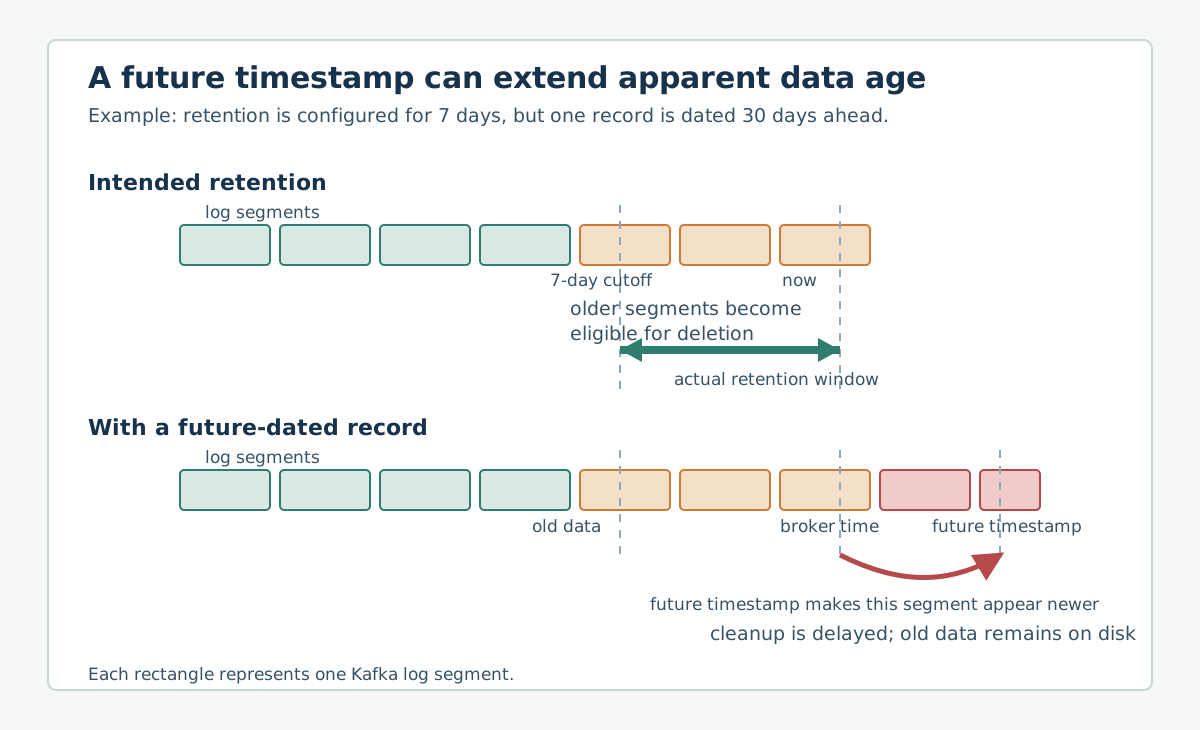
A future-dated record can make a segment appear newer than it really is, keeping old data on disk beyond the intended retention window.
This is why operators and administrators should care. Timestamp validation keeps the retention policy closer to the storage actually used by the cluster. A sensible future limit exposes bad data before it becomes disk pressure, delayed cleanup, or a confusing capacity forecast. The past limit needs attention too: set it too aggressively and a legitimate replay or backfill can fail when the team needs it.
Developers
For developers, it starts with producing timestamps Kafka can interpret correctly. Common problems include:
- Sending nanoseconds instead of milliseconds since the Unix epoch.
- Using a clock that is significantly ahead of the broker.
- Reusing an invalid timestamp during a replay or backfill.
- Applying a transformation that changes the timestamp’s unit or meaning.
- Assuming that a future timestamp is harmless because the record itself is accepted by the client.
These mistakes can cause INVALID_TIMESTAMP errors, reject an entire record batch, or make downstream event-time processing calculate the wrong windows and delays. In Kafka Streams, one bad event timestamp can put a record in the wrong window or change how a grace period is handled. In Apache Flink, it can push a watermark forward too early and close a window before the remaining events arrive. The reverse is possible too: a timestamp far in the past can hold the watermark back while the job waits for an event time that never appears. If the bad timestamp reaches Kafka, it can also contribute to the retention problems described above.
How one wrong event can affect a stream
Picture a five-minute aggregation receiving events around 10:00. One event really happened at 10:01, but the producer sends its timestamp in the wrong unit or gives it a date far in the future. The stream processor normally has no independent way to know that the value is wrong, so it treats the timestamp as truth. Kafka Streams may put the event in another window, change the aggregate, or consider the window complete at the wrong time. Flink may build a watermark from that future event and close the 10:00 window before the other valid events arrive. Those events may then be late, dropped, sent to a late-events side output, or handled through recovery logic.
The opposite error is harmful too. A timestamp far in the past can hold event-time progress behind the workload. That can delay windows, timers, joins, and alerts. One malformed event can make the results look like an application bug even though the processing code is doing what the timestamps tell it to do.
Developers should document whether a topic carries event time or ingestion time. They should use a shared timestamp conversion library, test boundary and replay cases, and monitor producer errors. Getting this detail right keeps application behavior predictable and stops a local data-format mistake from becoming a broker-storage problem.
What operators should check
Before enabling a stricter future limit, check both producers and existing topic policies:
- Confirm that clients send milliseconds since the Unix epoch.
- Check whether producer hosts synchronize their clocks.
- Identify replay and backfill jobs that intentionally use old event timestamps.
- Review topics using
CreateTimeand their retention and segment-roll settings. - Monitor
INVALID_TIMESTAMPresponses during rollout. - Set
log.message.timestamp.before.max.msandlog.message.timestamp.after.max.msbased on workload needs, not one universal guess.
A one-hour future window may be sensible for many applications, but it is not right for every system. Delayed processing, disconnected devices, and scheduled event production may need more room. The important improvement is that this choice is now visible and independent from the historical-data policy.
The larger design lesson
KIP-937 is more than a new pair of broker configurations. It recognizes that “old” and “future” are different data-quality problems. Kafka should support replay and historical imports, while making accidental future data difficult to introduce silently.
The proposal also points to a broader limitation in Kafka’s current message format: a record has one timestamp, and its meaning depends on whether the topic uses create time or append time. The KIP identifies capturing both client and broker timestamps as future work. That could eventually provide better observability and more precise retention decisions.
Conclusion
Timestamp validation sits between application correctness and broker operations. It is easy to ignore until a small producer bug reaches several systems at once. Storage behavior changes, retention expectations stop matching reality, monitoring becomes confusing, and event-time logic starts producing unexpected results.
KIP-937 gives Kafka a clearer policy model: configure how far records may be in the past and how far they may be in the future independently. Its compatibility-focused rollout gives teams time to find timestamp problems. Directional validation also makes the final policy easier to reason about. For Kafka operators and application owners, that is a small configuration change with a meaningful improvement in data integrity.